
TABLE OF CONTENTS
- Summary
- Before you start
- What is a profile?
- Profile sections breakdown
- Syncing profiles/updating information
- Profile deletion
Summary
Profiles allow you to have a comprehensive overview of the information associated with each individual or entity that you have verified via the Source, First AML's platform.
Before you start
Who can see profile information depends on your role and office assignment:
- Full Access — users in the same office as the case see all profile information.
- Limited Access — users outside the office see only name, email, and phone number.
- No Access — users see no profile information at all.
Agent, Author, and Frontline roles never have profile access, regardless of office settings.
For the full breakdown, including sharing profiles across offices, see Profile access in Understanding types of user roles.
What is a profile?
A profile is a centralised, comprehensive summary of an individual or entity. It brings together all relevant information in one place, making it easy to access and manage.
Within a profile, you can view:
The Overview
Verification reports
The Requirement library
Associated parties
Any ongoing monitoring activities
Profile sections breakdown
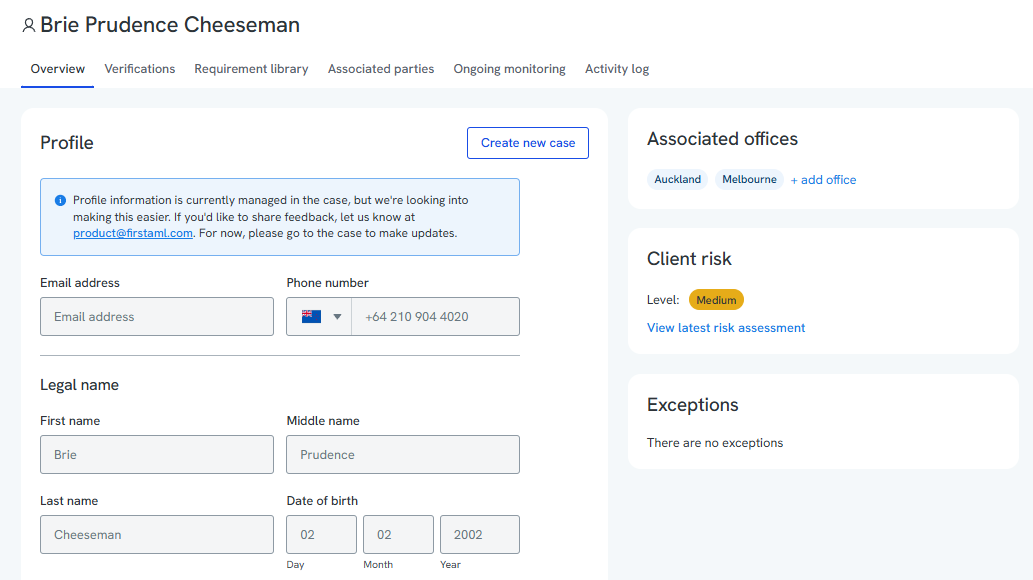
Overview
The Overview section displays key information about the individual or entity, including:
Full name
Date of birth
Address
Contact details
Any associated exceptions
Client Risk
Risk level from Client Risk Assessment
In individual and entity profiles, you'll see the risk level assigned from the latest submitted Client Risk Assessment (CRA) where that person or entity was included. This includes both standard and overridden risk levels.
How risk levels are synced:
- Entities must be the root entity in the case to display a synced risk level. (The root entity is the primary entity a case is built around — for example, the company being verified, as opposed to its related individuals or associated entities.)
- Individuals must:
- Require CDD (Customer Due Diligence).
- Not be associated with an entity in the case.
If an individual or entity is retrieved into a case after a CRA has been submitted, their risk level will display only if that case becomes the most recent CRA submission.
If an individual or entity is added after the CRA is submitted, their profile will still reflect the risk level from that assessment, as long as they meet the criteria above.
Verifications
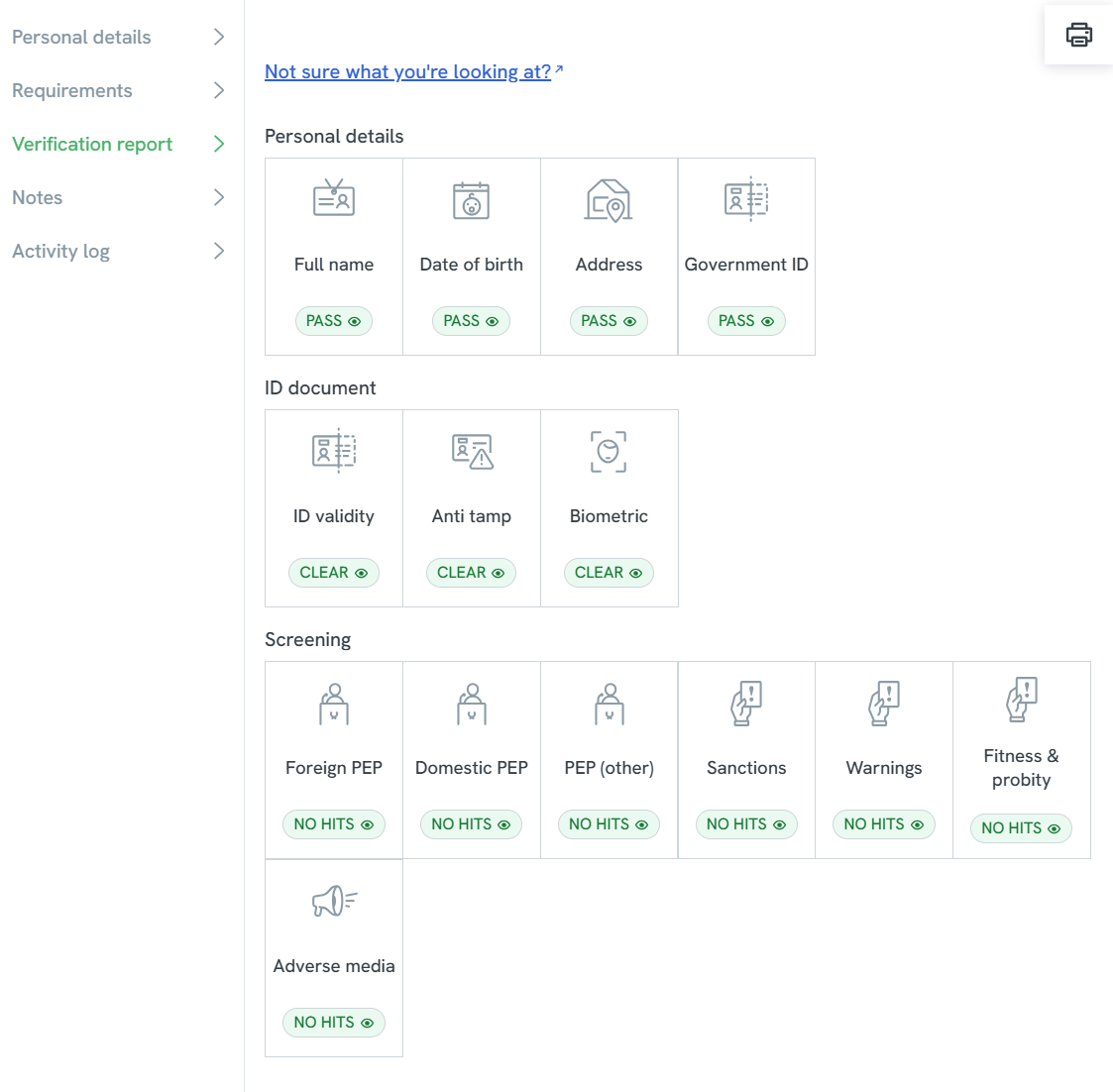
In the Verifications tab, you can view all verification reports that have been run on the individual or entity. You'll also see a list of cases where verifications have been completed.
If multiple verifications have been conducted within the same case, the most recent report will be displayed.
Requirement library
The Requirement Library provides a centralised list of all documents and information that have been requested or uploaded for the individual or entity.
If the same requirement has been requested across multiple cases, each instance will be shown separately, giving you a comprehensive overview of all submitted versions in one place.
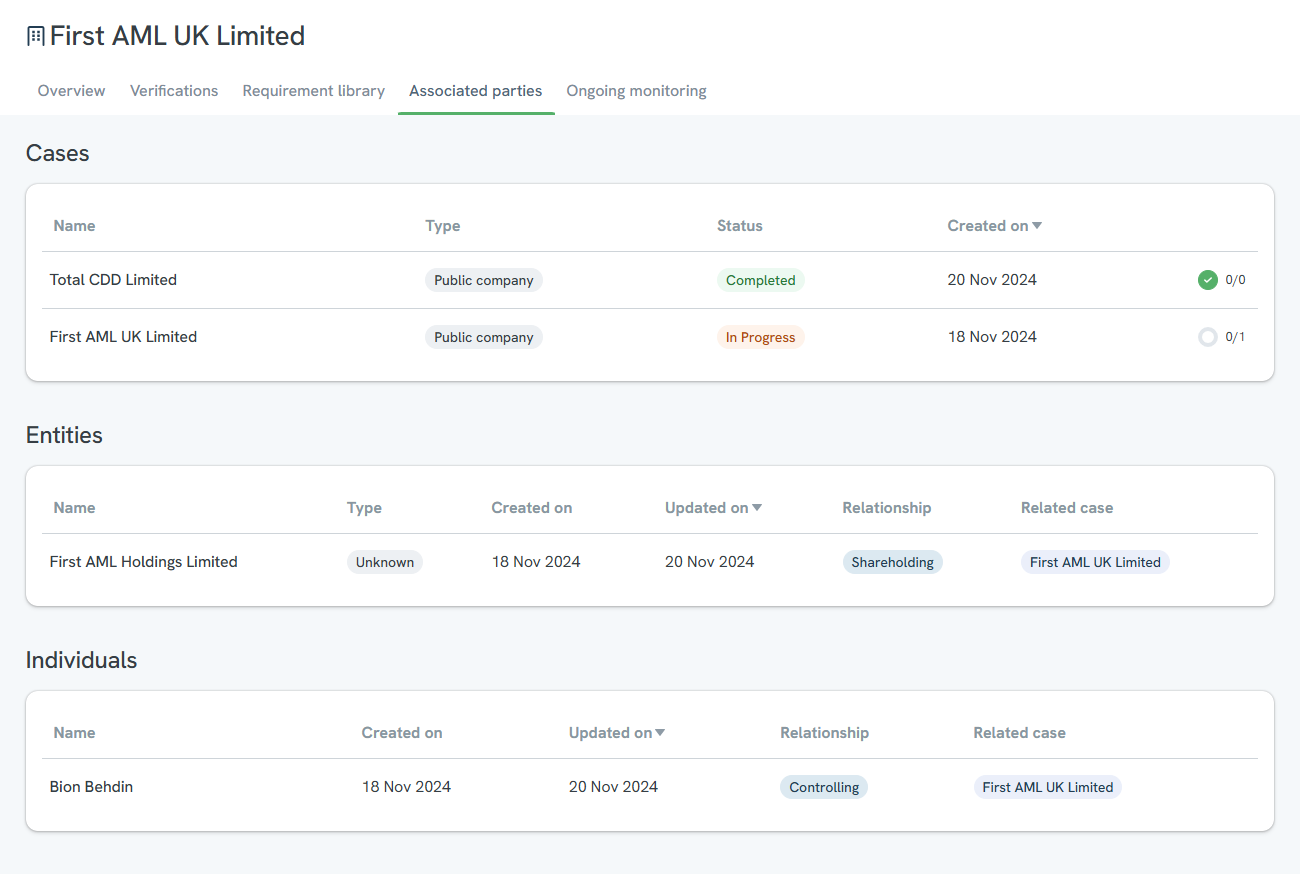
Associated parties
This tab displays all related cases, entity structures, and individuals where the profile appears within your platform.
It provides a quick view of how the profile is connected across different workflows, helping you understand its context and relationships.
Ongoing monitoring
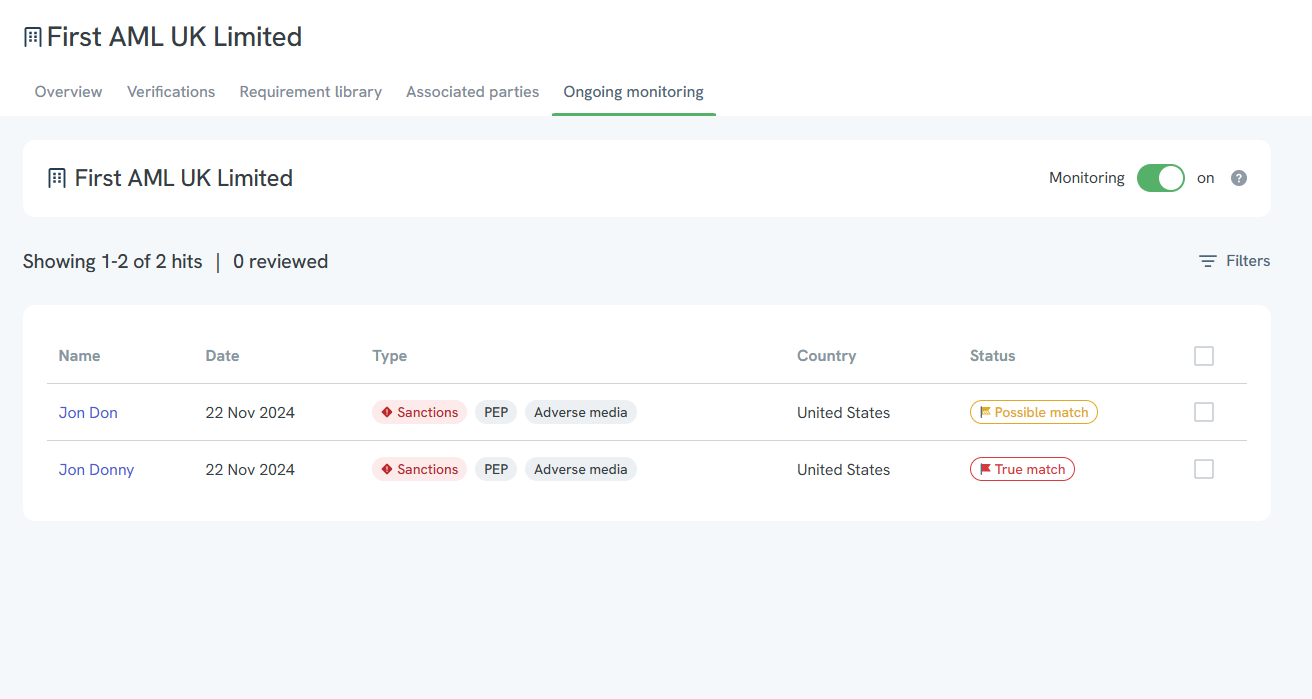
If Ongoing Monitoring is enabled on your platform, this tab allows you to:
Toggle monitoring on or off for the individual or entity profile
View any new hits or alerts related to sanctions, adverse media, or other watchlist activity
Syncing profiles/updating information
You cannot edit profile information directly from the profile. To update any details (e.g. name, date of birth, address), you must make the changes at the case level.
Note: If a profile is linked to multiple active cases, updating the information in one case (e.g. Case A) will prompt a sync notification in the others (e.g. Case B).
You can then choose to:
- Accept the sync to update Case B with the latest details from Case A, or
- Decline the sync if you need Case B to retain the original details for business or compliance reasons.
Profile deletion
When an individual or entity is removed from a case, First AML checks whether the associated profile is still used in any other cases.
If the profile is not linked to any other active cases, it will be automatically deleted.
This helps reduce clutter and ensures smoother performance during profile retrieval.
The same process applies when a case is deleted:
The system will assess all linked individuals and entities to determine if their profiles can also be safely deleted from the platform.
This automated clean-up helps maintain a tidy and efficient profile environment
Please see our article on Data Deletion for more information.